When we talk about Pentaksiran Bilik Darjah (PBD), it is clear that not all subjects benefit in the same way.
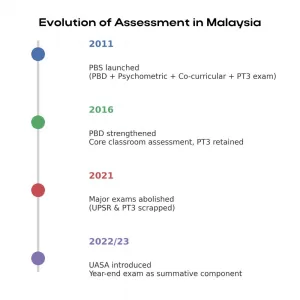
When PBD was first introduced, its focus was almost entirely on formative assessment: observing, guiding, and giving feedback during the learning process. The intention was to shift schools away from an exam-oriented culture. But many teachers and parents felt something was missing, especially for subjects that rely heavily on content mastery. This is why KPM later added UASA (Ujian Akhir Sesi Akademik) as a summative component, so that PBD now combines continuous classroom assessment with a structured year-end exam.
For English, which is a skills-based subject, the formative side of PBD works especially well. Language learning depends on continuous practice in listening, speaking, reading and writing. These are best captured through classroom tasks, projects and teacher observation, not just through exams. In my own English classes, I found that students who struggles in exams is not the same during role-plays or group discussions. PBD gave them a fairer chance to show what they could really do.
At one point in my career, I also taught Biology. That experience shaped how I view assessment in content-heavy subjects. Biology demands not only understanding of processes but also mastery of terminology and factual details. While experiments and projects helped students develop scientific skills, I realised that structured exam questions often revealed whether they had truly internalised what they learned. For example, a student might perform well in a lab activity but still struggle to clearly explain cell division in writing under exam conditions. In these cases, the exam provided a more reliable checkpoint of their overall mastery.
This contrast between my English and Biology classes made me more aware of how skills-based and content-heavy subjects respond differently to PBD.
With UASA now part of the picture, classroom assessment is no longer just about formative practices but also includes summative elements. To me, this marks a natural step forward from the earlier PBS era, which emphasised formative work, towards a system that gives space for both ongoing growth and final mastery.